The language problem in healthcare
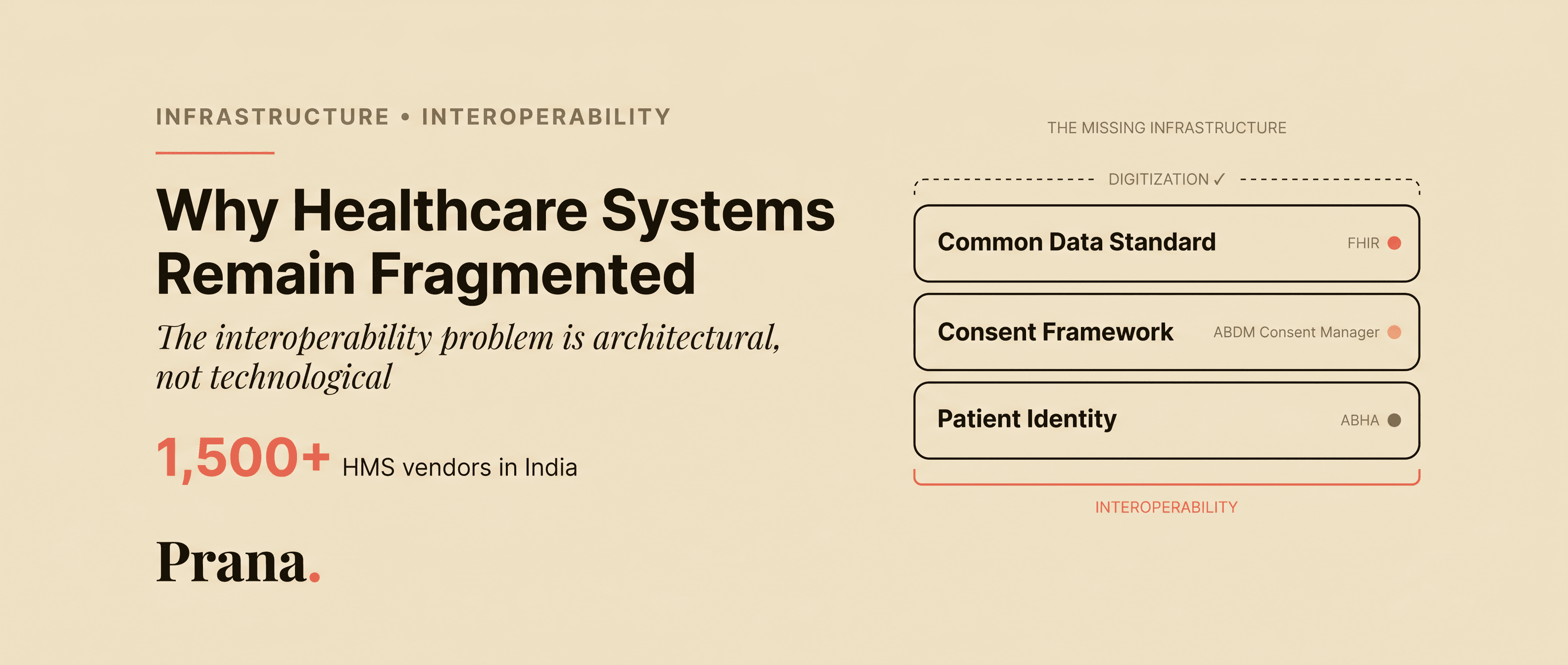
Healthcare data has historically been trapped in proprietary formats. Each HMS stores information its own way: different field names, different structures, different representations of the same clinical concepts. A prescription in one system looks nothing like a prescription in another.
This is not a technology failure. It is a language problem. Systems cannot exchange data because they do not share a common vocabulary for describing health information.
What FHIR is
FHIR (Fast Healthcare Interoperability Resources) is the international standard that gives health data a common language. Developed by HL7 International, FHIR defines how clinical information should be structured, labeled, and exchanged between systems.
When a hospital's records are transformed into FHIR, they become portable, readable by any ABDM-compliant system, anywhere. FHIR is the format that makes interoperability technically possible.
FHIR in the ABDM ecosystem
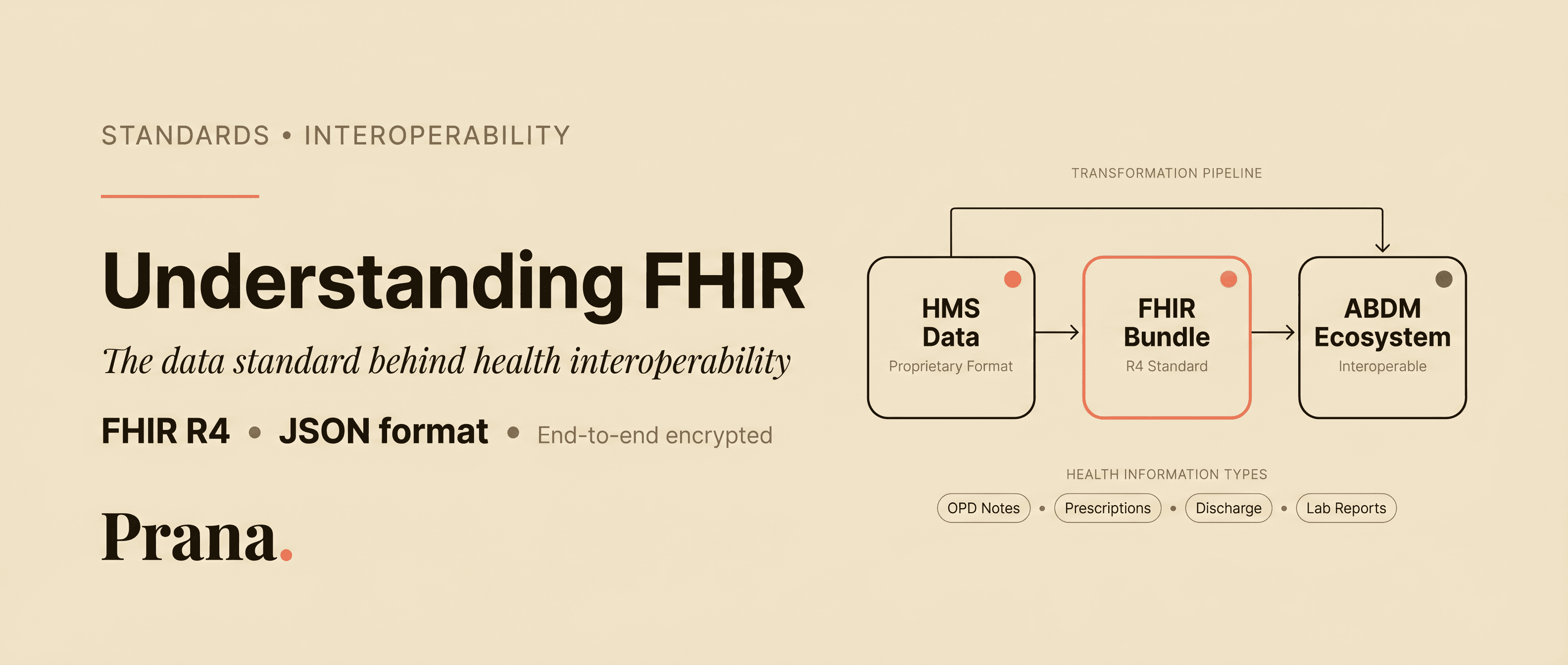
All health data in the ABDM ecosystem is structured and exchanged using FHIR R4. Every care context carries a FHIR-compliant bundle containing one or more health information types:
- OPD consultation notes
- Medication prescriptions
- Hospital discharge summaries
- Laboratory and diagnostic reports
- Vaccination records
- General health documents
- Wellness records
Health data transferred between systems is structured as FHIR bundles in JSON format, encrypted end-to-end during transfer, and organized into typed records that clinical systems can parse and display.
The transformation challenge
FHIR transformation is the core technical bottleneck of healthcare interoperability. Taking proprietary HMS data formats and converting them into standards-compliant FHIR bundles while maintaining clinical accuracy and completeness is genuinely complex.
Every HMS has its own data model. Every hospital has its own customizations. The transformation layer must understand the source format, map it to FHIR resource types, validate the output, and handle edge cases where clinical data does not map cleanly to standard structures.
This is not a one-time conversion. It is an ongoing infrastructure requirement. Every new record, every clinical encounter needs to be transformed in real time.
Why FHIR transformation matters
Without FHIR transformation, a hospital's existing records cannot participate in the ABDM ecosystem. The data stays trapped in its proprietary format, invisible to the national health infrastructure.
FHIR transformation is one of the core technical areas where interoperability infrastructure adds the most value, handling the complexity of standards compliance so that healthcare systems can focus on clinical care.
What transformation looks like in practice
Consider a common scenario: a patient has an OPD consultation at a mid-tier private hospital. The doctor writes notes in the HMS: diagnosis, medication prescribed, follow-up instructions. This information is stored in whatever format that specific HMS uses.
For this consultation to become a shareable health record in the ABDM ecosystem, several transformations must happen:
The HMS data must be extracted in its native format. Clinical concepts (medications, diagnoses, procedures) must be mapped to standard terminologies (SNOMED CT, ICD-10, LOINC). The record must be structured as a FHIR Composition resource with appropriate sections. The bundle must be validated against India's National Resource Centre for EHR Standards (NRCeS) implementation guide.
This is not simple format conversion. It requires understanding both the source system's data model and the clinical intent behind each field. A "Remark" field in one HMS might contain the diagnosis. A "Notes" field in another might contain the prescription. The transformation layer must handle this variation across hundreds of HMS implementations.
Why this cannot be solved piecemeal
If every HMS vendor builds their own FHIR transformation independently, the ecosystem gets 1,500 different implementations of varying quality, each solving the same fundamental problem. This duplication is inefficient, and the inconsistency creates interoperability failures downstream.
An infrastructure approach to FHIR transformation means solving it once, well, and making it available as a service that HMS systems connect to. The HMS vendor's expertise remains clinical software. The transformation complexity is handled by purpose-built interoperability infrastructure.