The scale of fragmentation
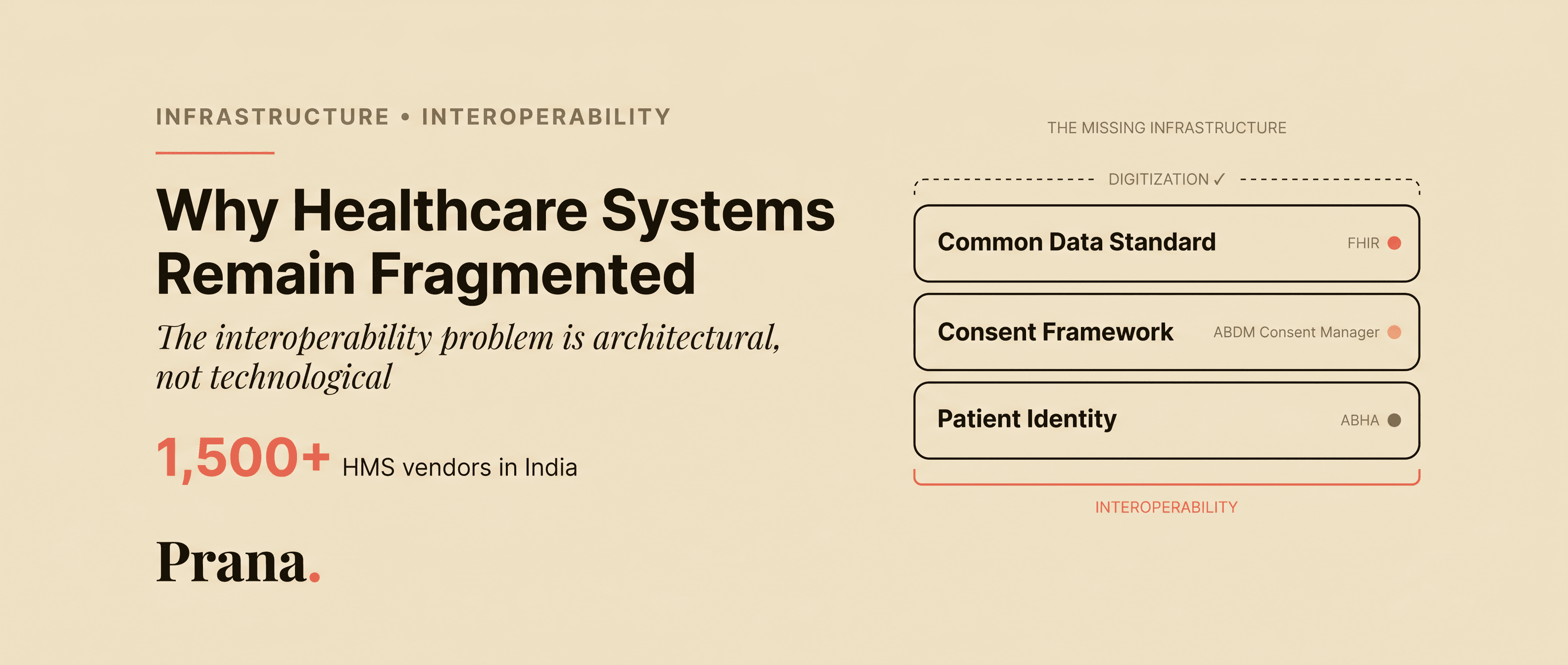
India has over 1,500 HMS vendors. Most hospitals have digitized their operations: patient records are in computers, not paper files. But digitization is not interoperability. Having records in a computer is not the same as having records that can move between systems.
Each HMS stores information in its own format, behind its own walls. A patient who visits two hospitals has two separate, disconnected health records. A lab report generated at one facility is invisible to the referring physician at another. The data exists. It just cannot travel.
An architectural problem
Healthcare fragmentation is not a technology failure. Most HMS systems are technically capable of exchanging data. The problem is architectural: there has been no national standard defining how health data should be structured, consented, and exchanged between systems.
Without a common data format, systems cannot understand each other's records. Without a consent framework, there is no governance for data exchange. Without identity infrastructure, there is no way to link records to the same patient across providers.
These are infrastructure problems, not feature problems. They cannot be solved by individual HMS vendors adding export buttons to their systems.
The operational cost of fragmentation
Fragmentation is not abstract. It has daily operational consequences in hospitals across India.
When a patient arrives at a new facility, there is no way to access their history from previous providers. The admitting physician starts from zero: repeating tests, re-taking histories, missing medication interactions that are documented elsewhere but invisible here.
When a referring physician sends a patient to a specialist, the referral information travels as a phone call, a paper note, or a WhatsApp message, not as a structured health record. The specialist's system cannot ingest it, search it, or integrate it with their own clinical workflow.
When a hospital needs to reconcile patient records for insurance claims, each encounter exists in its own system with its own format. Matching records across facilities requires manual effort that scales with volume. Every additional provider a patient visits adds complexity to the claims process.
These are not edge cases. They represent the daily operational reality for India's healthcare systems, and they cannot be solved by individual HMS vendors adding export buttons to their software.
The gap between digitization and interoperability
Digitization means records are electronic. Interoperability means records can move between systems with meaning preserved. The gap between the two is enormous.
Closing that gap requires three infrastructure layers that most healthcare systems do not have: a common data standard (FHIR), a consent governance framework (ABDM Consent Manager), and a universal patient identity (ABHA).
ABDM provides all three. But adopting ABDM requires each healthcare system to bridge its existing data formats to FHIR, integrate with consent workflows, and support ABHA at the point of patient registration.
Why HMS vendors are the critical enablers
India's healthcare interoperability challenge cannot be solved hospital by hospital. The scale is too large. The real leverage point is HMS vendors: the platforms that hospitals already use to manage their operations.
When an HMS vendor integrates with the ABDM ecosystem, every facility running that HMS gains interoperability capabilities. One integration, hundreds or thousands of facilities connected. This is why HMS vendors are the most important participants in the interoperability transition.
The infrastructure layer
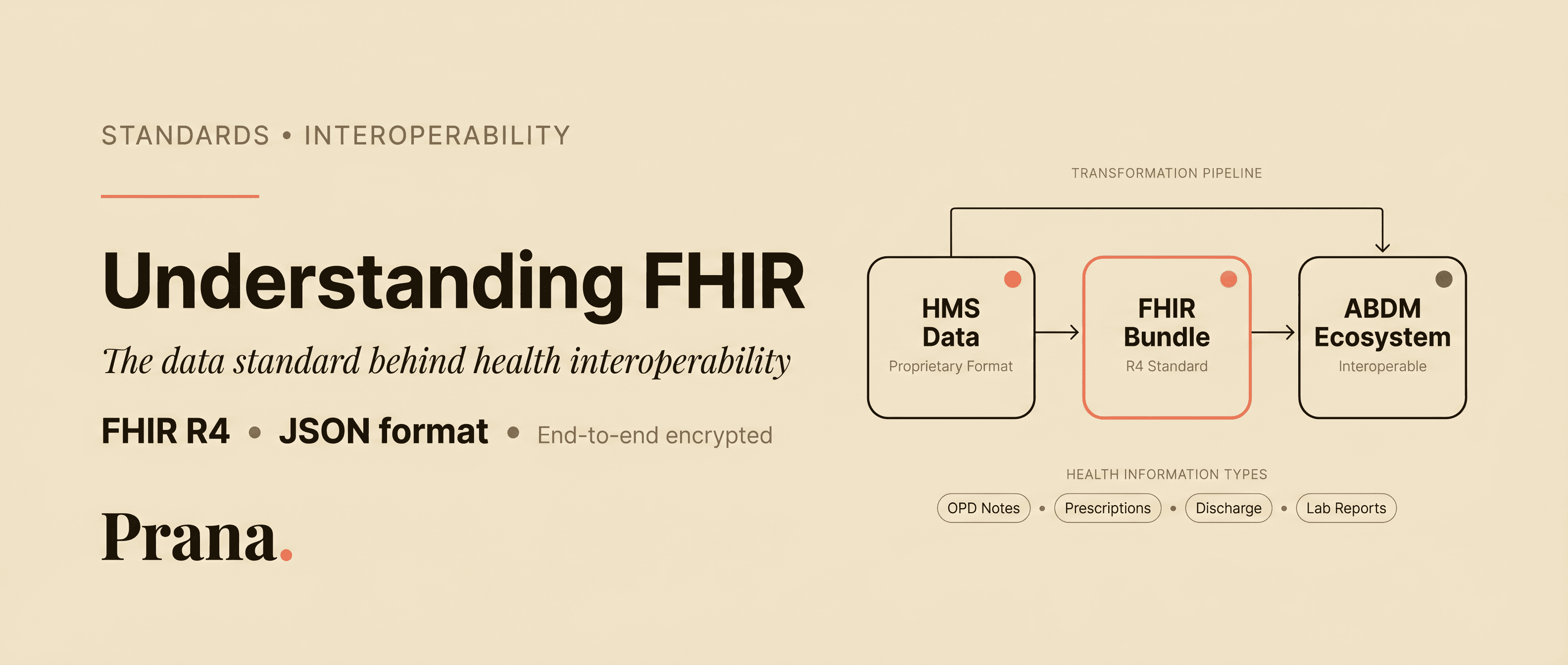
The missing piece in this picture is the interoperability infrastructure layer: the technical bridge between existing HMS systems and the ABDM ecosystem. This layer handles FHIR transformation, consent orchestration, care context management, and gateway communication.
Without this layer, every HMS vendor must build every ABDM integration component independently. With it, the complexity is handled as infrastructure, and healthcare systems can focus on clinical care.
This is the problem space that Prana is designed to address.