Consent as architecture
In the ABDM ecosystem, patient consent is not a compliance checkbox. It is the architectural foundation of every data exchange. No health record moves between systems without explicit, auditable, patient-controlled authorization.
This is a fundamental design choice, and it distinguishes ABDM from many other health data systems globally. The patient is not a passive subject of data exchange. The patient decides.
The consent lifecycle
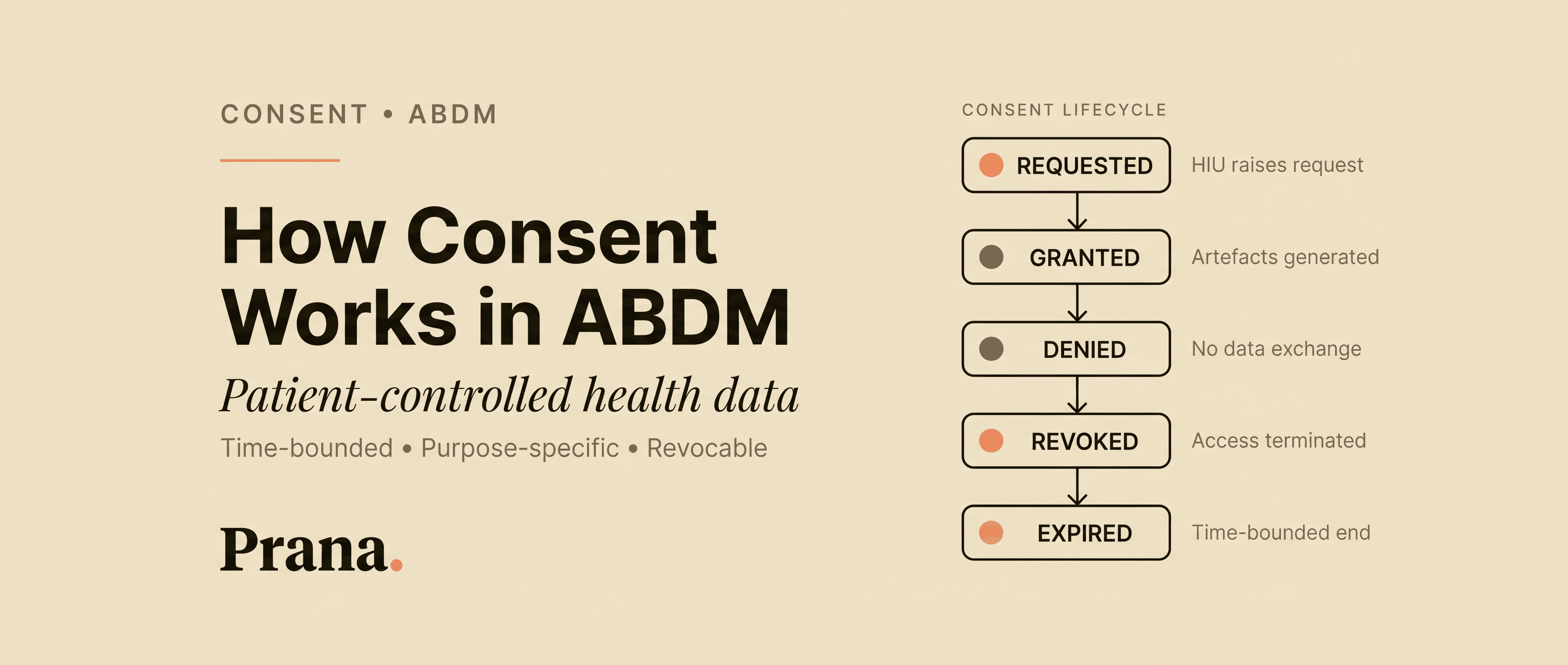
Every health data exchange in ABDM moves through a structured consent lifecycle with five states:
REQUESTED - A Health Information User has raised a consent request specifying the patient's ABHA address, purpose of access, date range of records needed, and which providers to fetch from. The request is awaiting the patient's decision.
GRANTED - The patient approved the request. Consent artefacts are generated (one per healthcare provider involved) authorizing the requesting system to fetch records from those specific providers. Records become available for retrieval.
DENIED - The patient rejected the request. No data exchange occurs. The decision is recorded.
REVOKED - The patient revoked a previously granted consent. Access is terminated. This can happen at any time during the consent period.
EXPIRED - The consent validity period has elapsed. Access is automatically terminated. The time-bounded nature of consent ensures that access does not persist indefinitely.
Consent artefacts and auditability
When a patient approves a consent request, the system generates formal consent artefacts. These are not abstract permissions. They are specific, scoped authorization objects:
Each artefact authorizes a specific requesting system to fetch records from a specific provider. The authorization is scoped to a defined time period and specific record types. Every artefact can be individually revoked per provider at any time. The system creates a timestamped record of every consent decision.
This creates a complete, auditable trail of who accessed what and when. For enterprise healthcare systems, this level of governance is not a nice-to-have. It is a requirement.
Consent for ongoing care
A common concern about consent-driven systems is friction: does the patient need to approve every individual request? ABDM addresses this through configurable auto-approval policies.
For trusted, recurring access patterns (such as a patient's regular clinic or an ongoing care relationship) patients can pre-authorize consent for specific providers. This maintains patient control without creating friction at every visit.
The balance between patient agency and operational efficiency is a design challenge that ABDM has addressed thoughtfully. Consent governs the architecture without impeding clinical workflow.
What this means for healthcare systems
For hospitals, HMS vendors, and health platforms, understanding the consent lifecycle is not optional. Every integration with the ABDM ecosystem must respect consent governance. Every data exchange must pass through the consent layer.
Systems designed around consent-first architecture, where consent is not bolted on but built in, will be better positioned for the interoperability era that ABDM is establishing.
Consent and India's data protection framework
The Digital Personal Data Protection Act (DPDPA) introduces additional governance requirements that intersect with ABDM consent. Under DPDPA, health data is sensitive personal data requiring explicit, informed consent for processing.
For healthcare systems, this means consent governance is no longer just an ABDM integration requirement. It is a legal obligation. Every entity handling patient health data must demonstrate:
Data minimization: collecting and sharing only what is necessary for the stated purpose. Purpose limitation: using health data only for the specific purpose the patient consented to. Storage limitation: retaining data only as long as the consent period specifies. Right to erasure: enabling patients to request deletion of their data from systems.
ABDM's consent architecture, with its time-bounded, purpose-specific, revocable consent artifacts, naturally aligns with these DPDPA requirements. Infrastructure designed around consent-first principles handles both regulatory frameworks simultaneously.
Governance as infrastructure
Consent is often treated as a user interface problem: a pop-up that says "I agree." In healthcare, it is an infrastructure problem.
Every data exchange must be traceable back to a specific consent decision. Every revocation must immediately halt access across all systems that received data under that consent. Every expiration must be enforced automatically, without relying on individual systems to check.
This is why consent orchestration must be handled at the infrastructure layer, not bolted onto individual HMS systems as an afterthought. The governance guarantees must be architectural, not implementation-dependent.