India is building national health infrastructure
Ayushman Bharat Digital Mission is not a single product or application. It is a national infrastructure layer that defines how patient records move between systems, governed by consent, structured by open standards.
ABDM establishes a unified ecosystem where patients, hospitals, laboratories, insurers, and health applications exchange health data securely. Patient consent governs every transaction. Understanding its architecture is essential for any healthcare system operating in India today.
The four foundational registries
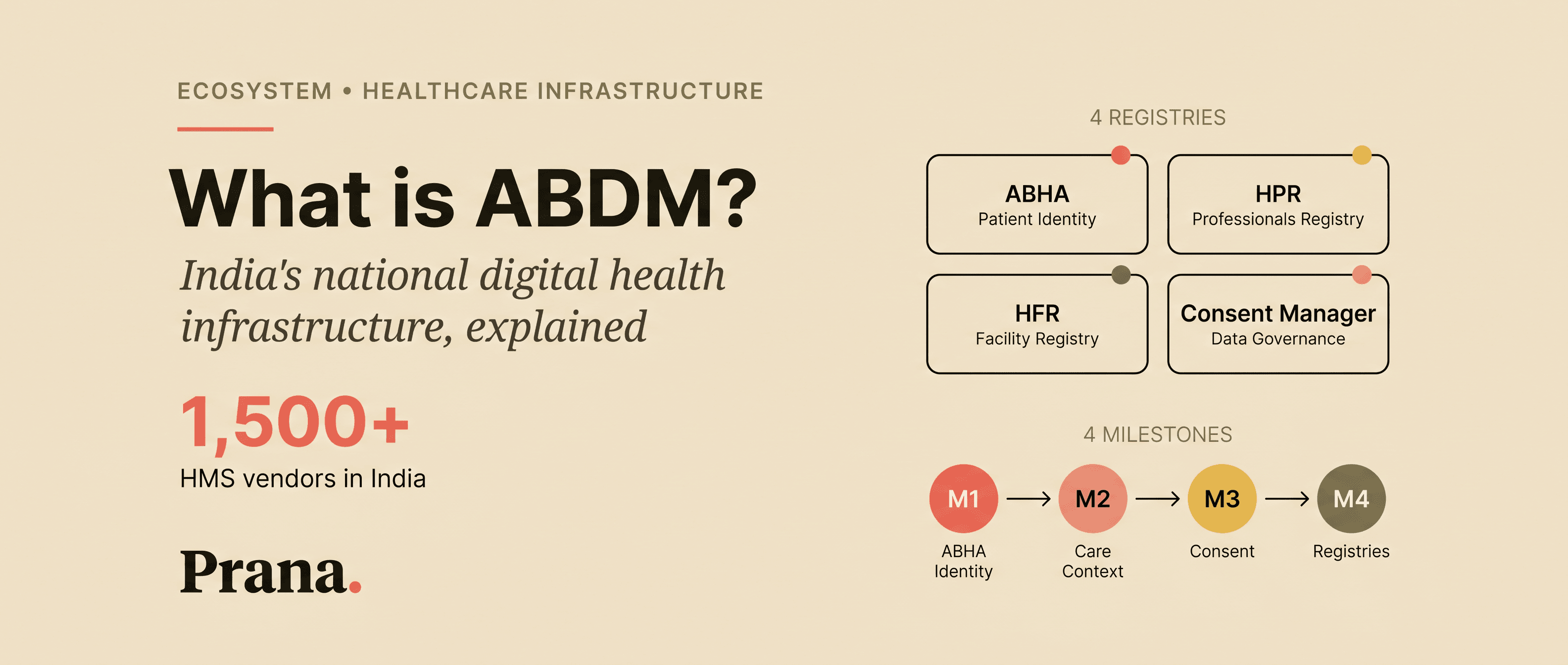
ABDM operates four structural registries that underpin the entire ecosystem:
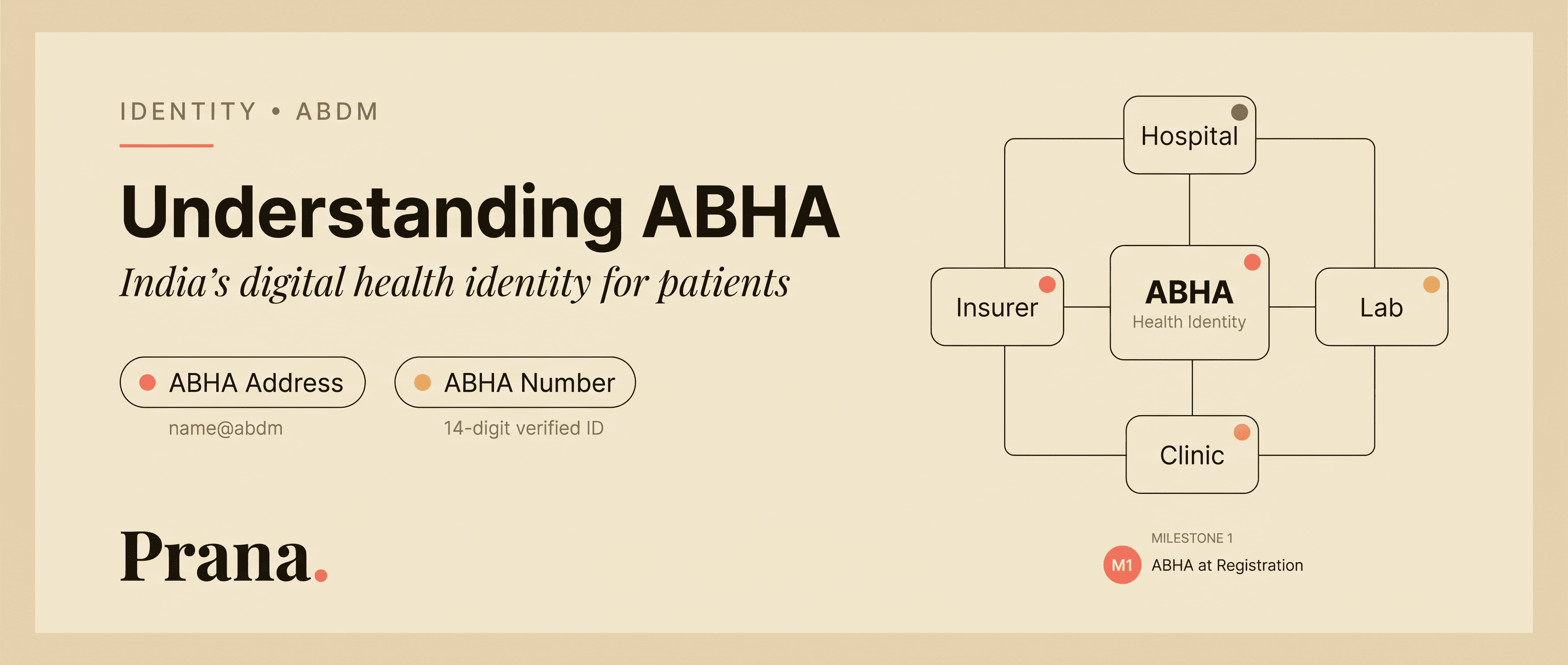
ABHA (Ayushman Bharat Health Account) is the unified patient health identity. For the first time, patients in India have a portable, system-agnostic health identity that follows them across hospitals, clinics, and labs.
HPR (Healthcare Professionals Registry) assigns every registered doctor and healthcare practitioner a unique digital identifier. This enables verified attribution of health records to specific practitioners.
HFR (Health Facility Registry) assigns every hospital, clinic, and lab a unique facility identifier. Facilities must be registered before they can participate in ABDM health data exchange.
Consent Manager orchestrates consent flows between Health Information Providers and Health Information Users. Every data exchange passes through consent governance.
Understanding HIP and HIU roles
Two core participant roles define every health data exchange in ABDM. Every healthcare facility that holds patient records is a Health Information Provider (HIP). Any system that requests those records, with the patient's permission, is a Health Information User (HIU).
Most hospitals eventually need to act as both. A platform like Prana helps HMS systems operate in both roles without building each integration layer independently.
The four implementation milestones
ABDM compliance is structured across four progressive milestones:
M1 - ABHA Identity. Patient account creation, KYC verification, and profile management. This is where most facilities begin.
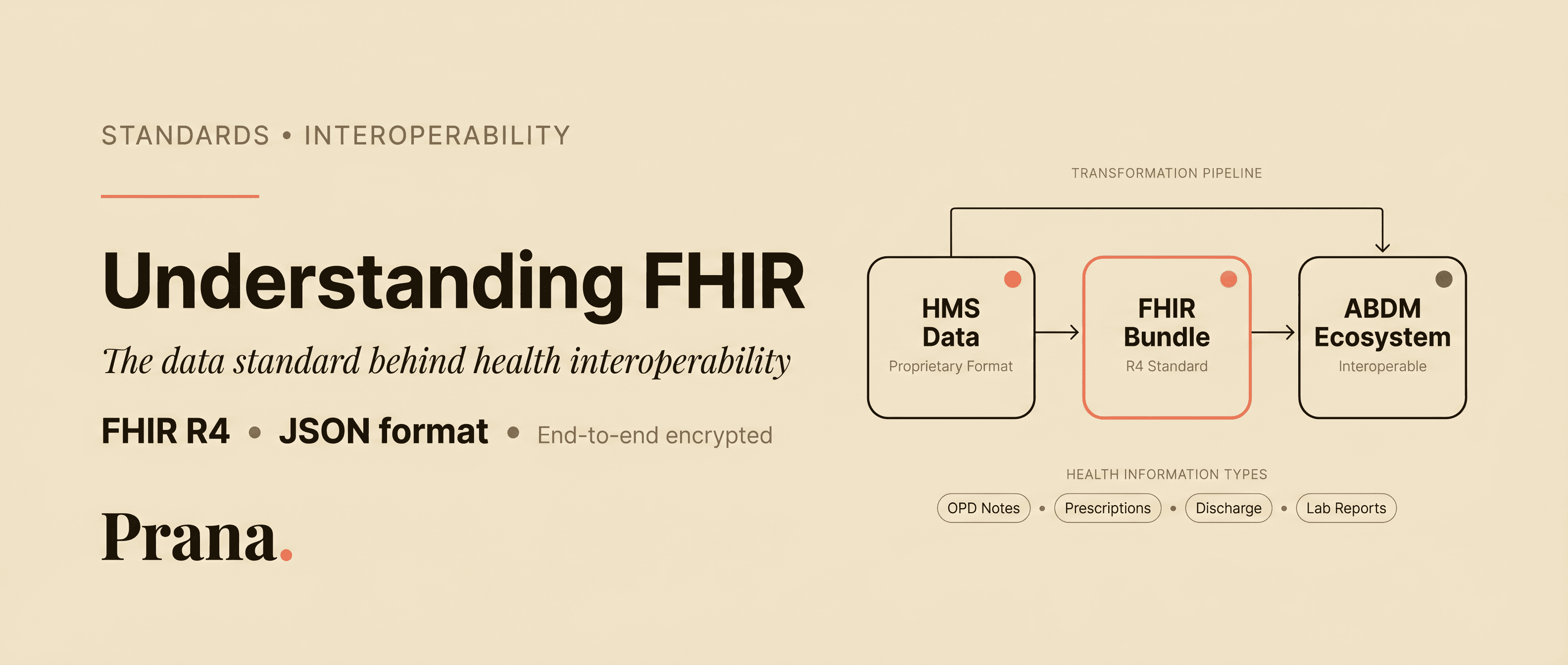
M2 - Care Context Linking. Health records are organized into care contexts and linked to patient ABHA identities. FHIR-compliant data serving begins.
M3 - Consent and Data Sharing. The full consent lifecycle is operational. Encrypted health data transfers between systems under patient governance.
M4 - Registry Onboarding. Healthcare professionals and facilities are registered in HPR and HFR, completing the institutional identity layer.
Each milestone builds on the previous. M1 must precede M2, which must precede M3. M4 is a prerequisite for M2. These dependencies define the integration sequencing that any interoperability layer must respect.
Why this matters for healthcare systems
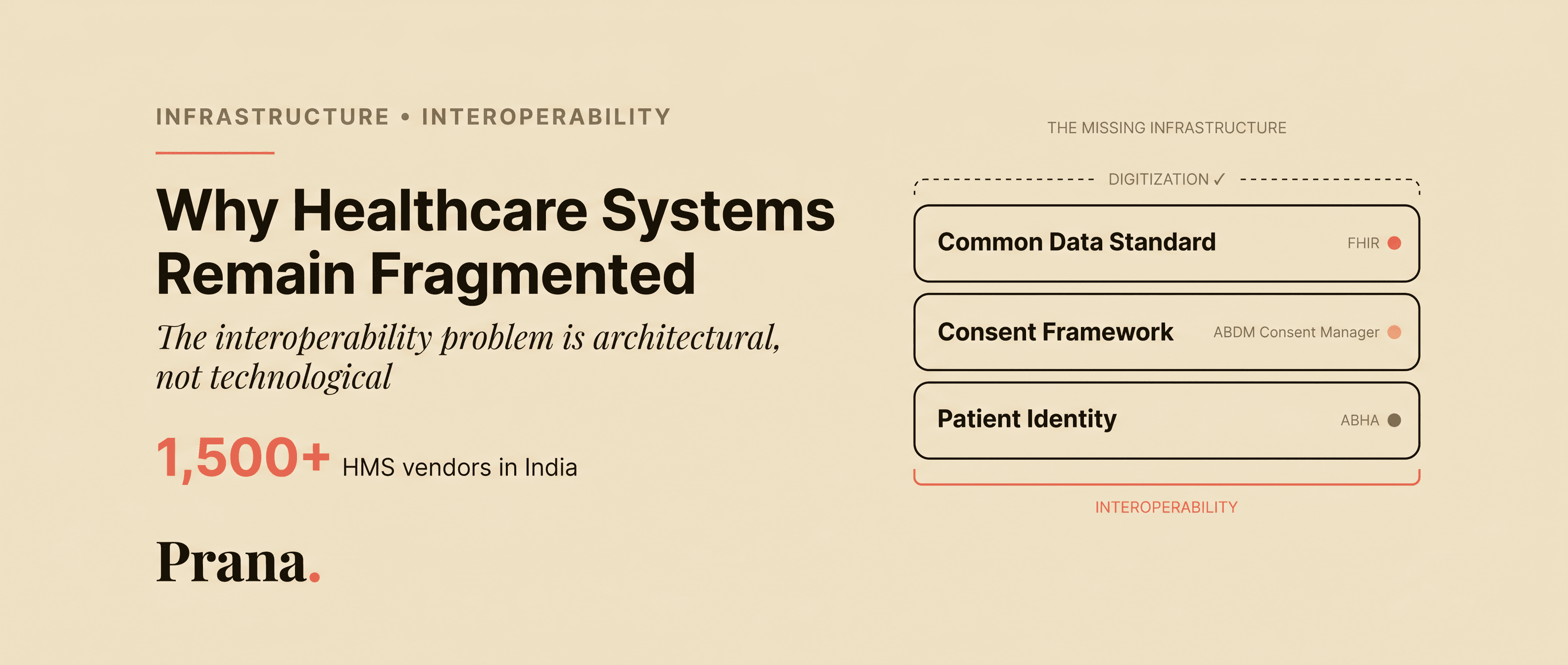
The gap between digitization and interoperability is enormous. India has over 1,500 HMS vendors. Most hospitals have digitized their operations. But digitization is not interoperability. Having records in a computer is not the same as having records that can move between systems.
ABDM is the first serious attempt at closing this gap at a national level. For hospitals, HMS vendors, clinics, and laboratories, understanding ABDM architecture is no longer optional. It is the foundation of where healthcare systems are heading.
The mandate convergence of 2025-2026
ABDM adoption is no longer purely voluntary for many healthcare facilities. Several regulatory forces are converging:
The National Medical Commission has begun tying hospital recognition and medical college evaluations to ABDM integration, specifically requiring HMIS systems to link with ABHA identities and produce structured health records.
AB-PMJAY (Ayushman Bharat insurance scheme) is increasingly conditioning hospital empanelment on ABDM readiness. For the approximately 36,000 empanelled hospitals, this creates a direct financial incentive: facilities that cannot demonstrate ABDM compliance risk losing access to government insurance reimbursement.
IRDAI has mandated that all insurers and third-party administrators adopt the National Health Claims Exchange (NHCX), which operates under ABDM infrastructure. This creates downstream pressure on hospitals to produce ABDM-compliant discharge summaries and claims data.
For hospital administrators and HMS vendors, ABDM integration is transitioning from a "nice to have" to a board-level operational requirement. The infrastructure to bridge existing systems to these standards is no longer optional. It is time-sensitive.